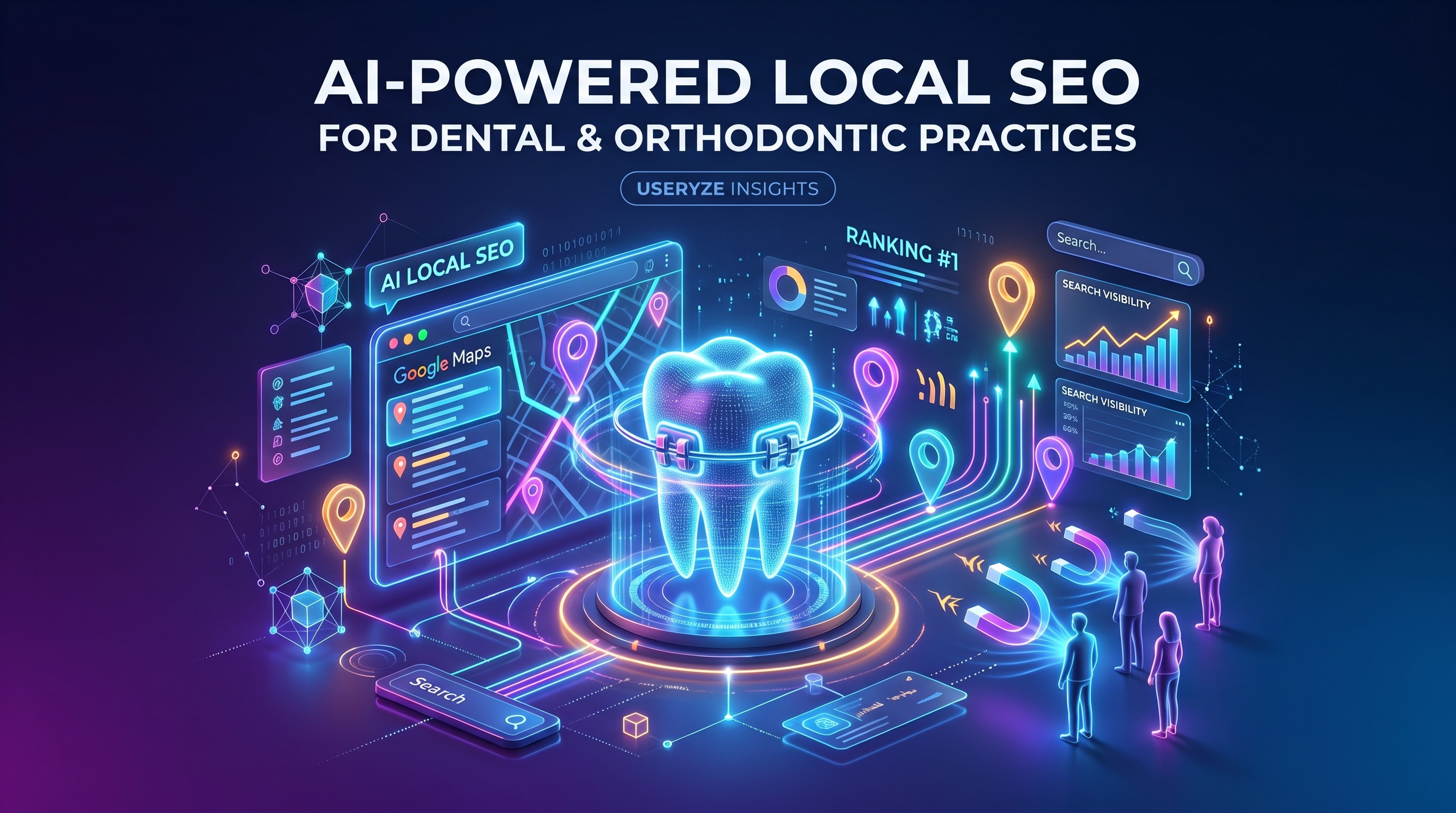
AI-Powered Local SEO Strategies for Dental & Orthodontic Practices: Attract More Patients
Updated: October 27, 2026
E-commerceQuick Summary
13 min read- 01
Running a thriving dental or orthodontic clinic requires exceptional clinical expertise, a welcoming staff, and state-of-the-art operatory technology. Yet, many practice owners face an...
- 02
The digital landscape has fundamentally changed. A decade ago, securing a reliable flow of new patients was straightforward. A clean website, a basic Google Maps pin, and a handful of...
- 03
At the same time, prospective patients no longer search the way they used to. They do not settle for a generic dentist; they demand specialized solutions within minutes of their home or...
- 04
To thrive, practice owners must adapt to modern discovery mechanisms. This is where AI local SEO dental practices become an essential asset. Artificial intelligence is not merely a tool for...
011. Introduction: The Modern Patient Acquisition Dilemma
Running a thriving dental or orthodontic clinic requires exceptional clinical expertise, a welcoming staff, and state-of-the-art operatory technology. Yet, many practice owners face an unexpected operational bottleneck: the patient acquisition engine. Despite investing substantial capital into digital campaigns, premium equipment, and comfortable waiting rooms, empty appointment slots remain a frustrating reality.
The digital landscape has fundamentally changed. A decade ago, securing a reliable flow of new patients was straightforward. A clean website, a basic Google Maps pin, and a handful of positive reviews were often enough to stay ahead of nearby competitors. Today, search engine algorithms update continuously, organic visibility shrinks as paid advertising space expands, and the competitive density of suburban and urban markets has reached unprecedented heights.
At the same time, prospective patients no longer search the way they used to. They do not settle for a generic dentist; they demand specialized solutions within minutes of their home or workplace. They search via mobile voice queries during their morning commute, consult conversational AI platforms to understand orthodontic pricing, and rely on Google Map packs to make rapid booking decisions.
To thrive, practice owners must adapt to modern discovery mechanisms. This is where AI local SEO dental practices become an essential asset. Artificial intelligence is not merely a tool for automated administrative tasks; it is a transformative driver of local visibility and customer acquisition. By combining machine learning with local search optimization, clinics can capture high-intent local demand before competing practices even realize those searches took place.
2. Why Local SEO Is the Growth Engine for Dental and Orthodontic Clinics
Healthcare delivery, particularly oral health, is inherently local. While an e-commerce brand can market products nationwide, a clinic's revenue base is defined by a strict geographic radius. Most patients are unwilling to travel more than twenty to thirty minutes for routine cleanings, pediatric care, or recurring orthodontic adjustments.
Because of this physical boundary, general national SEO strategies produce virtually zero return on investment for local healthcare providers. Ranking for a broad term like "clear aligners" does not generate booked chairs if the visitor lives three states away. Conversely, capturing position one for a localized search like "Invisalign certified provider North Austin" directly drives high-value consults.
Local SEO serves as the growth engine for your practice due to several key factors:
High Patient Intent and Immediate Conversion
When an individual searches for an emergency dentist, a pediatric provider, or an adult orthodontic consultation, they are rarely browsing casually. They are experiencing discomfort, seeking an aesthetic smile makeover, or looking for an established practitioner for their child. These searches signal acute intent to book. Ranking at the top of local map results captures patients at the exact moment their decision-making process peaks.
High-Value Procedure Margins
The financial health of modern dental and orthodontic practices relies heavily on elective, cosmetic, and comprehensive procedures. Dental implants, full-mouth reconstructions, surgical extractions, and multi-year orthodontic aligner packages represent substantial lifetime value per patient. A sustained lift in local visibility for these targeted services creates an immediate and positive impact on monthly practice revenue.
The Decisive Authority of the Google Local Pack
Google reserves the top visual real estate on mobile devices for the Local 3-Pack, the trio of business locations displayed beneath an interactive map. Research shows that over forty percent of clicks for local healthcare searches go directly to these three listings. If your practice ranks on standard organic page two or outside the top three map positions, your clinic is effectively invisible to a substantial percentage of potential patients.
Establishing a dominant presence requires continuous updates, nuanced local content, clean technical data, and active review management. For busy practice managers and solo practitioners, keeping pace manually is nearly impossible. This is why forward-thinking clinics deploy patient acquisition strategies AI to automate, scale, and optimize their search performance.
3. Optimizing Your Google Business Profile with Artificial Intelligence
Your Google Business Profile (GBP) functions as the virtual front door of your dental practice. For many prospective patients, it is the first and only asset they evaluate before calling your front desk or booking through your patient portal. Managing this profile goes beyond entering an address and phone number; it requires constant, algorithmically aligned optimization.
Artificial intelligence enhances GBP performance across several foundational areas:
AI-Assisted, Region-Specific Business Descriptions
Search engines analyze your primary business description to evaluate your clinical specialties and geographic relevance. AI natural language tools can evaluate high-ranking competitors in your exact market, identify semantic gaps, and generate highly targeted practice descriptions.
Rather than relying on generic statements like "We provide comprehensive dental care for the whole family," AI models synthesize patient-centric copy that highlights specific procedures, community landmarks, and neighborhood service areas. This aligns your profile with the precise phrases potential patients enter into search engines.
Dynamic Service Listings and Attribute Enrichment
Google allows practices to list discrete clinical services, such as sleep apnea therapy, ceramic braces, wisdom tooth extraction, and laser dentistry. However, static service titles often miss long-tail search volume.
AI platforms can monitor emerging regional search queries and automatically suggest additions or enhancements to your service menu. If inquiries for "teeth whitening treatments" surge locally ahead of the spring wedding season, AI tools identify that shift, allowing your practice to update service descriptions and custom pricing attributes instantly.
Intelligent Local FAQ Generation
The Questions and Answers section on your GBP is a valuable, often neglected ranking asset. Prospective patients frequently ask:
- "Do you offer emergency Saturday appointments?"
- "What clear aligner brands do you carry?"
- "Are dental x-rays covered under Medicaid at this location?"
AI tools can analyze historical patient inquiries from front-desk software and incoming emails to generate a comprehensive, clinically accurate repository of common questions. By pre-populating your GBP with verified questions and answers written in clear, reassuring language, your practice addresses clinical anxieties instantly while sending strong semantic signals to Google's ranking algorithm.
Automated Review Sentiment Analysis and Review Response
Online reputation is a foundational ranking pillar in orthodontic practice marketing AI. Machine learning algorithms can continuously monitor incoming patient reviews, assess emotional sentiment, and flag clinical concerns or negative feedback for immediate manual follow-up.
For positive reviews, AI systems can draft personalized, compliant responses that acknowledge the patient's kind words while naturally incorporating relevant clinical and local keywords, such as "orthodontic treatment in South Tampa" or "gentle pediatric dental staff."
4. AI-Driven Hyperlocal Keyword Strategy and Patient Intent Mapping
Traditional dental keyword research was once restricted to checking monthly search volumes for basic terms like "dentist [city]" or "orthodontist [neighborhood]." In competitive markets, these broad keywords are extremely costly to target via paid ads and slow to rank for organically.
Modern search algorithms have transitioned from exact keyword matching to semantic search, prioritizing user intent, context, and topical authority. AI tools empower practices to target micro-geographies and specific treatment intents with extraordinary precision.
Uncovering Micro-Intent and Semantic Search Clusters
Patients search through unique lenses of urgency, demographic context, and clinical preference. AI algorithms excel at analyzing vast datasets of search interactions to identify high-value long-tail clusters, including:
- Urgency and Timing: "same day broken tooth repair downtown", "weekend emergency tooth pain relief".
- Demographics and Lifestyle: "pediatric dentist specialized in sensory sensitivity", "orthodontist for adults [city] with financing plans".
- Technology and Materials: "metal-free dental implants near me", "bpa free clear aligners [neighborhood]".
Targeting these granular terms yields significantly higher conversion rates. A patient searching for "orthodontist for adults [city]" knows precisely what they need, has the financial means to pursue treatment, and is looking for a practice that specifically caters to adult lifestyles rather than a solely pediatric clinic.
Neighborhood-Level Content Localization
To rank across a large metropolitan or suburban area, clinics often struggle to demonstrate relevance across multiple zip codes. Manually drafting original, localized service pages for six distinct surrounding suburbs frequently results in repetitive, low-quality content that search engines penalize.
AI assists in generating localized content that incorporates genuine geographic nuance. By ingesting local census figures, regional landmarks, school district boundaries, and nearby arterial roads, AI helps practice owners draft authentic educational content.
A dedicated page for pediatric services can naturally reference local elementary schools, sports complexes, and family-friendly community centers. This demonstrates to search engines that your practice is an active, verified pillar of that specific micro-community.
To explore how these technical processes fit within a broader digital approach, you can learn more about advanced AI search visibility platforms designed to automate multidimensional search rankings.
5. Dominating Voice Search and Answer Engine Optimization (AEO) in Healthcare
Search behavior is increasingly shifting toward voice assistants and generative artificial intelligence engines. Patients no longer sit exclusively behind desktop keyboards; they use smart speakers, in-car voice systems, and smartphone assistants while on the go. Furthermore, platforms like Google AI Overviews, ChatGPT, and Perplexity are transforming standard search result pages into direct conversational answer engines.
Winning in this landscape requires Answer Engine Optimization (AEO). AEO focuses on engineering your digital content so AI answer engines select your practice as the single, authoritative solution to a user's verbal or conversational query.
The Mechanics of Conversational Voice Search
Voice searches are structurally different from text queries. While a desktop user might type "best orthodontist braces cost", a voice search user will ask:
"Hey Siri, who is the highest rated orthodontist near me that offers affordable monthly payment plans for teenagers?"
Voice queries are longer, phrased as full sentences, and naturally question-centric. Dental practices must structure their websites to answer these conversational questions directly.
AI-powered natural language processing helps practices identify the precise syntax and conversational questions used by local patients. By embedding structured FAQ sections throughout your service pages, your practice becomes the prime candidate for voice assistants to read aloud as the authoritative answer.
Structuring Content for Zero-Click Answers
Modern patients often find answers directly on the search engine results page without clicking through to a website. While this trend might initially sound counterproductive for traffic, appearing as the primary source in an AI Overview establishes immense clinical authority.
When Google's generative engine displays a synthesized answer to "How much do clear aligners cost in Chicago?", having your practice cited as the verified source drives massive brand recognition and direct phone calls.
To achieve this visibility, content must be formatted with programmatic clarity:
- Provide direct, concise answers in the first forty to sixty words of every section.
- Use clear subheadings that mirror common clinical questions.
- Support every medical assertion with clear clinical context and doctor attribution.
Practices seeking a deeper understanding of how these mechanisms translate across consumer categories can review our breakdown of local search and answer engine optimization principles, which outlines the technical foundations shared across location-dependent businesses.
6. Hypothetical Case Study: Apex Orthodontics
To understand the tangible impact of these strategies, consider the hypothetical trajectory of Apex Orthodontics, a mid-sized clinic situated in a highly competitive suburban corridor outside a major metropolitan hub.
The Baseline Challenge
Apex Orthodontics was founded by two board-certified specialists with over fifteen years of combined clinical experience. Despite their exceptional patient outcomes, modern digital clinic, and positive local word-of-mouth, their patient acquisition had plateaued.
Two corporate dental support organizations (DSOs) had recently opened nearby, running substantial pay-per-click ad campaigns that drove up bidding costs for standard keywords. Apex Orthodontics was languishing between positions six and ten on the Google Local 3-Pack for primary terms like "orthodontist near me". Furthermore, their website had negligible visibility for adult aligners, which represented their most profitable clinical focus.
The AI-Powered Strategy
Working with an AI-focused digital agency, the practice executed a three-pronged local search campaign:
- Hyperlocal Intent Mapping: The clinic deployed machine learning tools to evaluate the local market. The analysis uncovered significant search volume across adjacent school districts for phrases such as "phase one interceptive orthodontics for kids" and "discreet adult braces for working professionals". The team generated eight dedicated, clinically reviewed resource guides addressing these specific procedures and linking them directly to local community contexts.
- Dynamic Google Business Profile Enrichment: The clinic used AI tools to overhaul their GBP. They added comprehensive, keyword-rich descriptions for over thirty distinct procedures, implemented an AI-curated patient FAQ repository, and deployed automated sentiment alerts to respond to all incoming patient reviews within twenty-four hours.
- Voice Search and Structured Data Schema: The clinic restructured its core treatment pages using conversational headers and embedded advanced schema markup denoting their clinic type, accepted insurance networks, geographic coordinates, and physician certifications.
The Measurable Outcomes
Within six months of deploying these automated workflows, Apex Orthodontics achieved the following verifiable improvements:
- Google Maps Impressions: Local 3-Pack impressions across a ten-mile radius increased by 142 percent, securing the clinic a top-three position for over twenty-five high-value search phrases.
- Inbound Phone Inquiries: Direct phone calls generated via the Google Business Profile listing increased by 64 percent month-over-month.
- Adult Treatment Starts: New consultations for adult clear aligners rose by 48 percent, directly attributed to targeted neighborhood service pages.
- Reduction in Patient Acquisition Cost: Because their organic and map visibility captured prospective patients organically, the clinic reduced its monthly paid advertising expenditure by 35 percent while maintaining a consistently full appointment schedule.
This case study demonstrates that clinical excellence must be supported by digital visibility. When a practice optimizes its digital footprint for modern search algorithms, patient acquisition becomes predictable and sustainable.
7. Conclusion: The Useryze Advantage for AI-Powered Local SEO
The landscape of dental and orthodontic marketing has evolved beyond basic directory submissions and manual keyword stuffing. As search engines integrate artificial intelligence more deeply into their ranking frameworks, practices that rely on legacy marketing tactics will steadily lose ground to clinics that adopt modern technology.
AI local SEO is not about replacing the human element of your practice. It is about removing the operational friction of digital marketing, uncovering hyper-targeted patient demand, and presenting your clinical authority clearly to both search algorithms and human patients. By optimizing your Google Business Profile, targeting conversational voice searches, and deploying rich structured data, your clinic establishes an enduring digital moat.
Navigating this transition requires technical precision, clinical understanding, and advanced software tools. This is where Useryze delivers a clear competitive advantage. Our platforms are built to bridge the gap between complex artificial intelligence and practical patient acquisition. We help practice owners transform their digital presence from a passive informational site into an automated patient acquisition engine.
If you are ready to expand your patient volume, secure your local market, and lead your region in digital visibility, explore our specialized dental and orthodontic marketing solution sand discover how intelligent local SEO can elevate your practice.
Ready to Turn Local Search into a Predictable Patient Engine?
Empty chairs and stagnant consult numbers do not have to be the baseline for your dental or orthodontic practice. While your local competitors continue to rely on outdated, manual directory tactics, you can capture high-value search visibility before prospective patients ever look anywhere else.
At Useryze, we build intelligent, AI-powered local search systems engineered specifically for modern dental and orthodontic clinics. From dominating the Google Local 3-Pack to capturing high-intent voice queries and AI Overviews, we help you secure the top positions that drive booked appointments.
Take the first step toward practice growth today:
- Claim Your Free AI Search Visibility Audit: Discover where your practice ranks across local map packs, identify hidden keyword opportunities, and pinpoint exactly where you are losing patients to competing clinics.
- Schedule a Strategy Call with Our Healthcare Specialists: Learn how our automated optimization frameworks can integrate seamlessly with your existing front-office workflows to scale qualified patient inquiries.
Related Posts
View All ›
Discover how Conversion Rate Optimization (CRO) helps dental and orthodontic practices turn website traffic into booked appointments. Learn key CRO strategies to boost patient acquisition.

Discover how targeted dental website conversion rate optimization (CRO) turns casual web traffic into booked patient appointments. Learn actionable CRO strategies for CTAs, testimonials, mobile UX, and online forms.

Discover how AI local SEO for restaurants transforms foot traffic into loyal diners. Learn actionable AEO for restaurant marketing tactics to dominate search engines and AI answer engines.