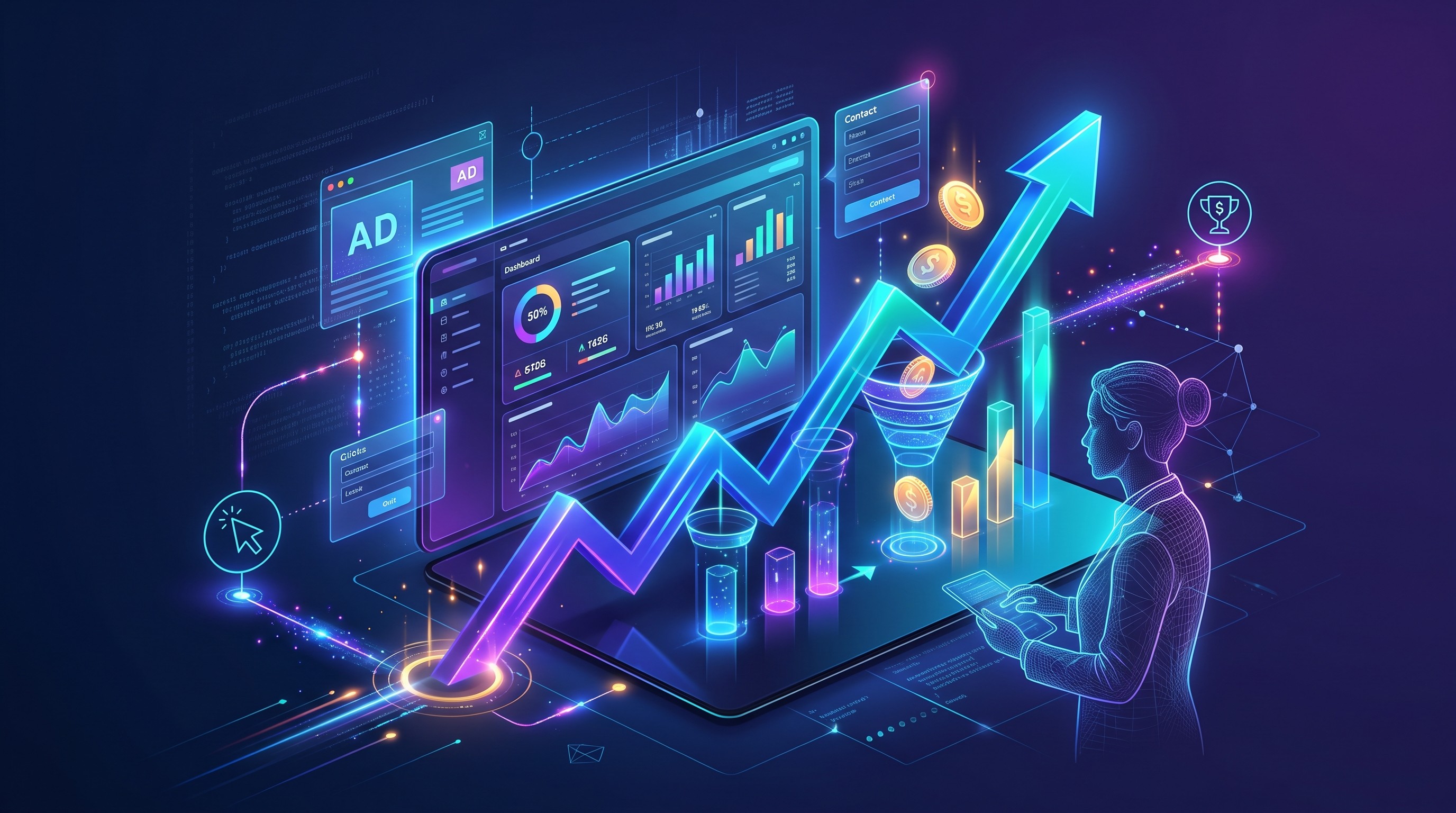
Maximizing ROI: How CRO Makes Your Paid Ads More Profitable for Small Businesses
Updated: October 28, 2026
E-commerceQuick Summary
14 min read- 01
If you run paid campaigns on Google Ads or Meta Ads for your small business, you already know the harsh truth: acquiring customers through paid digital channels has never been more...
- 02
For many small business owners, the standard playbook used to be simple. You identified a set of high-intent keywords, drafted three ad variations, launched an automated Meta traffic...
- 03
Today, that approach is often a direct path to unprofitable unit economics. Pouring more capital into paid acquisition without addressing how your visitors behave after clicking will merely...
- 04
To increase ad ROI as a small business, you must look beyond your ad dashboard. The lever that unlocks sustainable profitability is paid ad conversion optimization, which bridges the gap...
011. Introduction: The Rising Cost of Paid Ads and the Need for Efficiency
If you run paid campaigns on Google Ads or Meta Ads for your small business, you already know the harsh truth: acquiring customers through paid digital channels has never been more competitive or expensive. Over the past few years, privacy updates, automated bidding systems, and an influx of competing brands have driven average Cost Per Click (CPC) and Cost Per Mille (CPM) metrics upward across nearly every vertical.
For many small business owners, the standard playbook used to be simple. You identified a set of high-intent keywords, drafted three ad variations, launched an automated Meta traffic campaign, and waited for purchases or service calls to roll in. If you needed more revenue, you simply increased your daily ad budget.
Today, that approach is often a direct path to unprofitable unit economics. Pouring more capital into paid acquisition without addressing how your visitors behave after clicking will merely accelerate how quickly your budget is depleted. When traffic costs climb 20 percent to 40 percent year over year, the business that survives and scales is not the one spending the most. It is the business that captures the highest possible revenue out of every single click.
To increase ad ROI as a small business, you must look beyond your ad dashboard. The lever that unlocks sustainable profitability is paid ad conversion optimization, which bridges the gap between what happens inside the ad platform and what happens on your website. For a deeper breakdown of this dynamic, explore our companion analysis on how CRO makes your PPC campaigns more profitable.
2. The Problem: Clicks Without Conversions
Consider the anatomy of a standard paid search or paid social campaign. You spend hours writing compelling ad headlines, designing crisp creatives, selecting audiences, and dialing in negative keyword lists. Your ads get clicked. Your platform reporting shows hundreds of visits arriving at your store or landing page.
Then, silence.
No purchases occur, your contact forms sit idle, and your bounce rate remains alarmingly high. This scenario illustrates the classic "clicks without conversions" dilemma, and it is the single largest source of wasted spend in modern digital advertising.
Most small business owners mistakenly interpret poor conversion performance as an ad issue. They assume their targeting was flawed, that Google brought the wrong demographic, or that Meta algorithmically distributed impressions to bot accounts. While ad targeting certainly matters, the root cause is far more frequently found on the post-click side of the equation.
When a prospective buyer clicks your ad, they arrive with a specific expectation, a specific question, or a specific emotional driver. If your page takes four seconds to load, drops them onto an unfocused homepage, forces them to search through a convoluted navigation bar, or presents a clunky twelve-field form, they will leave immediately. The ad network fulfilled its contractual obligation by delivering the click and charging your credit card. The post-click experience, however, dropped the ball.
Every bounce is paid inventory that produced zero return. To calculate the compounding cost of this lost opportunity on your bottom line, plug your current numbers into our conversion ROI calculator to see what even a minor lift in conversion efficiency can save your business.
3. What is CRO and Its Direct Impact on Paid Ads?
Conversion Rate Optimization (CRO) is the systematic process of increasing the percentage of website visitors who complete a desired action, such as buying a product, submitting a lead form, booking a consultation, or downloading a resource. Unlike broad brand design overhauls that rely on subjective opinions, CRO relies on user behavior analytics, customer feedback, and iterative testing.
To understand its role in your growth strategy, it helps to distinguish traffic acquisition from on-site optimization. Traffic generation fills the top of the funnel, while CRO ensures that the bottom of the funnel does not leak. For a thorough walkthrough of these boundaries, review our guide on understanding the difference between digital marketing and CRO.
The relationship between CRO and paid advertising performance is direct, mathematical, and immediate. When applied to paid campaigns, CRO transforms paid ad metrics in three structural ways:
A Direct Reduction in Cost Per Acquisition (CPA)
Your customer acquisition cost is directly governed by your conversion rate. If you spend 1,000 dollars on clicks and convert at 1 percent, you gain 10 customers at an acquisition cost of 100 dollars each. If through systematic PPC CRO strategies you improve your conversion rate to 2 percent, that same 1,000-dollar spend yields 20 customers. Your CPA drops immediately to 50 dollars. You have doubled your customer acquisition volume without spending a single additional cent on ads.
Improved Ad Platform Quality Scores
Both Google Ads and Meta Ads reward advertisers who provide seamless user experiences. Google Ads explicitly incorporates "Landing Page Experience" into its Quality Score algorithm. A high Quality Score lowers your effective CPC during ad auctions, allowing you to win top positions at lower bids than your competitors. By optimizing your page speed, technical usability, and relevance, CRO lowers your upfront click costs.
Higher Bidding Agility and Market Dominance
In any auction-based advertising market, the business that can afford to spend the most to acquire a customer will win the auction. When your landing pages convert twice as efficiently as your direct competitors, your allowable CPA headroom increases. You can outbid competitors on high-intent, premium search terms because your revenue extraction per visitor is fundamentally superior.
4. Key CRO Levers for Paid Campaigns
To build an ad funnel that routinely converts traffic at peak rates, you need to execute practical, high-impact changes across four critical pillars.
A. Landing Page Optimization
A generic homepage is not a landing page. One of the costliest mistakes small business owners make is sending paid campaign traffic to their homepage. Homepages are inherently designed for browsing; they are packed with dozens of links, multiple company updates, about sections, and competing calls to action. Paid traffic requires singular focus.
Message Match
Your ad headline and your landing page headline must speak the exact same language. If your Meta ad promises "Affordable Boutique Accounting for Dental Practices," your landing page must not open with a vague banner stating "Comprehensive Financial Solutions for Tomorrow." A failure in message match causes instant cognitive dissonance. Within the first two seconds, the user questions whether they clicked the wrong link, and they navigate back to the feed.
Clear and Compelling Calls to Action (CTAs)
Eliminate all visual competition surrounding your primary goal. Remove your standard website navigation menu, social media icons, and auxiliary footer links from dedicated paid landing pages. Give the user a clear path forward. Ensure your call to action button states the exact benefit they receive upon clicking, such as "Claim Your Free Roof Inspection" rather than a passive, generic "Submit."
Mobile Speed and Performance
More than 70 percent of paid social clicks and a massive share of paid search traffic originate from mobile devices. If your landing page takes longer than three seconds to load on a standard mobile connection, you will lose upwards of half of your audience before your first paragraph is even rendered. Compress images, reduce script bloat, use modern asset caching, and verify mobile layout fluidity.
B. A/B Testing Ad Copy and Landing Page Elements
Optimizing paid funnels is never a one-time setup; it is an ongoing experimental process. True PPC CRO strategies tie your creative testing in the ad network directly to variations on your site.
Headline and Hook Testing
Test emotional angles against direct value propositions. For example, if your service is residential pest control, does a fear-relief angle ("Keep Pests Away from Your Family Tonight") outperform a cost-efficiency angle ("Reliable, Fixed-Price Pest Extermination")? Pair each top-performing ad variation with an identically themed landing page headline to identify which hook resonates deepest.
Visual Hierarchy and Social Proof
Test how you display credibility indicators. For local service businesses, placing verified customer reviews, Google rating badges, and trade certifications above the fold can dramatically reduce user hesitation. Test whether short video testimonials convert better than quote cards accompanied by customer photos.
C. Funnel Optimization
Friction is anything that slows down, confuses, or prevents a user from taking your desired action. Small businesses often burden prospective customers with unnecessary hurdles.
Form Field Minimization
Every additional field you include on a lead generation form reduces your conversion rate. Ask yourself what information your team genuinely needs on the very first touchpoint. Can you collect just a first name, email address, and phone number now, and gather project specifications during the discovery call? If a complex form is unavoidable, break it into a multi-step progressive form with a progress bar, which feels far less intimidating to a mobile user than a single long form.
Frictionless Checkout Processes
If you run an e-commerce business using Google Shopping or Meta Catalog ads, evaluate your cart-to-checkout sequence. Are you forcing customers to create an account before buying? Enable guest checkout. Do you introduce unexpected shipping fees late in the process? Clarify shipping costs upfront. Add trusted one-click payment options such as Apple Pay, Google Pay, and Shop Pay to reduce manual data entry on mobile screens.
D. Post-Conversion Nurturing
Your conversion process does not conclude when a user clicks the final submit button. The moments immediately following a conversion offer prime real estate to reinforce trust, lower buyer remorse, and lift total customer value.
Optimized Thank You Pages
Replace blank confirmation notifications with actionable thank you pages. For service businesses, explain the exact next steps: "Thank you for reaching out. A senior project manager will call you within 15 minutes during business hours. In the meantime, see how our process works in this 60-second video." This reduces customer drop-off before your sales team can initiate outreach.
Immediate Automated Value Delivery
Deliver what was promised without delay. If your ad promoted a free consultation guide or a promotional discount code, trigger an immediate SMS or email receipt containing that asset. High-performing nurture sequences turn immediate post-conversion momentum into repeat transactions and long-term brand equity.
5. Real-World Scenarios: How CRO Multiplies Ad Profitability
To see how these concepts translate into real revenue for small businesses, let us examine two hypothetical scenarios that demonstrate the direct relationship between conversion improvements and profitability.
Scenario A: The Local HVAC Contractor (Lead Generation)
A regional residential HVAC contractor spends 4,000 dollars each month on Google Search Ads targeting emergency furnace and AC repairs.
- Original Baseline Performance:
- Monthly Ad Spend: 4,000 dollars
- Average Cost Per Click (CPC): 8.00 dollars
- Monthly Clicks: 500
- Conversion Rate (sending clicks to the standard homepage): 3.0 percent
- Total Leads: 15
- Cost Per Lead (CPL): 266.67 dollars
- Close Rate on Leads: 33 percent
- New Customers: 5
- Customer Acquisition Cost (CAC): 800 dollars
- After Applying Dedicated CRO and Landing Pages: The business stops sending ad traffic to its broad homepage. They create dedicated, lightning-fast mobile landing pages that match search intent ("Emergency AC Repair Available 24/7"). They add a prominent click-to-call button floating at the top of the mobile screen, embed local trust badges, and reduce their contact form to three essential fields.
- Monthly Ad Spend: 4,000 dollars
- Average Cost Per Click (CPC): 7.20 dollars (improved due to higher Google Quality Scores)
- Monthly Clicks: 555
- Conversion Rate: 8.5 percent
- Total Leads: 47
- Cost Per Lead (CPL): 85.11 dollars
- Close Rate on Leads: 33 percent
- New Customers: 15.5 (rounded to 15)
- Customer Acquisition Cost (CAC): 266.67 dollars
By simply resolving post-click friction, the business tripled its customer acquisition without adding a single dollar to its monthly ad budget, while cutting its acquisition cost by nearly two-thirds.
Scenario B: The Direct-to-Consumer Home Goods Brand (E-Commerce)
An emerging direct-to-consumer brand selling ergonomic desk accessories spends 6,000 dollars per month running targeted product ads across Instagram and Facebook.
- Original Baseline Performance:
- Monthly Ad Spend: 6,000 dollars
- Average CPC: 1.50 dollars
- Monthly Clicks: 4,000
- E-Commerce Conversion Rate: 1.2 percent
- Total Orders: 48
- Average Order Value (AOV): 85 dollars
- Total Revenue: 4,080 dollars
- Return on Ad Spend (ROAS): 0.68x (operating at an active loss)
- After Implementing E-Commerce CRO Adjustments: The founder analyzes user session replays and notices shoppers are abandoning the mobile product pages because shipping costs are invisible until the final checkout step, and the primary product options are buried beneath technical specs. They implement sticky "Add to Cart" buttons, introduce clear free-shipping thresholds directly on the product detail page, showcase verified buyer photos, and activate one-click mobile checkout options.
- Monthly Ad Spend: 6,000 dollars
- Average CPC: 1.50 dollars
- Monthly Clicks: 4,000
- E-Commerce Conversion Rate: 2.8 percent
- Total Orders: 112
- Average Order Value (AOV): 92 dollars (boosted by a free-shipping threshold offer)
- Total Revenue: 10,304 dollars
- Return on Ad Spend (ROAS): 1.72x
Without increasing their ad spend, the brand shifted from an unsustainable, money-losing campaign to a profitable acquisition engine that generates positive cash flow every week.
6. Integrating CRO with Your Paid Ad Strategy
Executing conversion rate optimization alongside active paid campaigns requires a clean, repeatable workflow. You do not need a massive enterprise team to execute this; you simply need disciplined operational alignment.
Step 1: Align Strategy Before Spending
Do not create ad campaigns and landing pages in isolation. If your marketing agency or in-house specialist is designing ad creative without simultaneously architecting the exact destination page, pause the campaign. Map the journey end to end. Clarify the core value proposition, the expected user intent, and the exact next step before committing any media spend.
Step 2: Establish Quantitative and Qualitative Tracking
You cannot fix friction you cannot see. Ensure your Google Analytics 4, Meta Conversions API (CAPI), and Google Tag Manager setups are firing clean, deduplicated events. Complement this quantitative data with qualitative insights by deploying heatmaps and session recordings. Watching fifty real users navigate your landing page will reveal broken elements, confusing copy, and navigation dead-ends faster than any theoretical design review.
Step 3: Run Structured, Isolated Tests
Avoid changing seven page variables at once. If you change the headline, hero background image, button color, and form layout all on the same afternoon, you will have no idea which change drove your conversion lift or drop. Isolate your variables or use disciplined split testing so you can draw clear, actionable conclusions from every test cycle.
Step 4: Conduct Periodic Full-Funnel Audits
Consumer habits, competitor offerings, and platform features change constantly. What converted visitors effectively last quarter may begin to experience fatigue today. Schedule regular full-funnel reviews across your advertising and web assets to keep your messaging sharp and your funnels streamlined. For professional support in identifying conversion bottlenecks across your entire digital presence, explore the strategic options available through our tailored CRO services.
7. Conclusion: Get More from Your Ad Spend with Useryze
Spending money on Google Ads or Meta Ads without a dedicated conversion optimization strategy is like trying to fill a bucket with holes in the bottom. You can open the tap wider and pour in more water, but your water bill will rise while the bucket remains half empty.
The most reliable, predictable way to scale a small business through paid digital advertising is not to cross your fingers and hope ad costs drop. It is to take full control over the user experience the moment a visitor lands on your site. By aligning message match, removing form friction, enhancing mobile performance, and testing high-impact page elements, you turn every marketing dollar into an efficient, scalable revenue engine.
Stop letting valuable, hard-won clicks bounce away. At Useryze, we specialize in transforming standard paid ad traffic into measurable business growth. We help small businesses identify hidden conversion leaks, build high-converting landing page experiences, and implement end-to-end testing systems that slash acquisition costs and elevate campaign ROI.
Ready to stop wasting your ad budget and make your marketing genuinely profitable? Connect with the team at Useryze today, explore our full suite of conversion optimization services, and build a paid advertising funnel that drives predictable, scalable revenue for your business.
Related Posts
View All ›
A grounded approach to running Google Ads for jewelry brands. Learn how to manage Performance Max, protect brand search, and optimize for high-value conversions.


An operational analysis of why jewelry brands should prioritize funnel efficiency over increased ad spend to ensure sustainable growth and healthier unit economics.

Scaling ad spend on a leaking store drains margin. Here are five practical signals that your jewelry business needs funnel engineering, not more traffic.