Why Discounting Harms Luxury Jewelry Brands (And What to Do Instead)
Updated: October 13, 2026
E-commerceQuick Summary
5 min read- 01
Discounting fine jewelry erodes gross margin, trains buyers to wait for sales, and signals that retail markup was inflated. Unlike fast fashion, fine jewelry relies on perceived intrinsic...
- 02
Instead of slashing prices, resilient jewelry operators drive conversions by offering value-add incentives. Tactics like complimentary ring sizing, bundled care kits, custom engraving, and...
- 03
┌─────────────────────────────────────────────────────────┐ │ THE DISCOUNT TRAP │ │ │ │ 20% Off Sale ──> Cash Flow Spike ──> Margin Compression │ │ │ │ │ ▼ │ │ Trained Deal Seekers │ │ │ │ │...
- 04
To understand why price cuts fail high-AOV brands, look at the margin structure. Fine jewelry typically operates on lower inventory velocity than fashion, balanced by higher average order...
Discounting fine jewelry erodes gross margin, trains buyers to wait for sales, and signals that retail markup was inflated. Unlike fast fashion, fine jewelry relies on perceived intrinsic value, craft, and permanence. When a brand offers a 20 percent sitewide markdown, it trades long-term brand equity for a temporary spike in cash flow. Over time, repeat purchase rates at full price collapse, return rates increase, and customer acquisition costs climb because ad algorithms optimize for deal-seekers rather than high-LTV collectors.
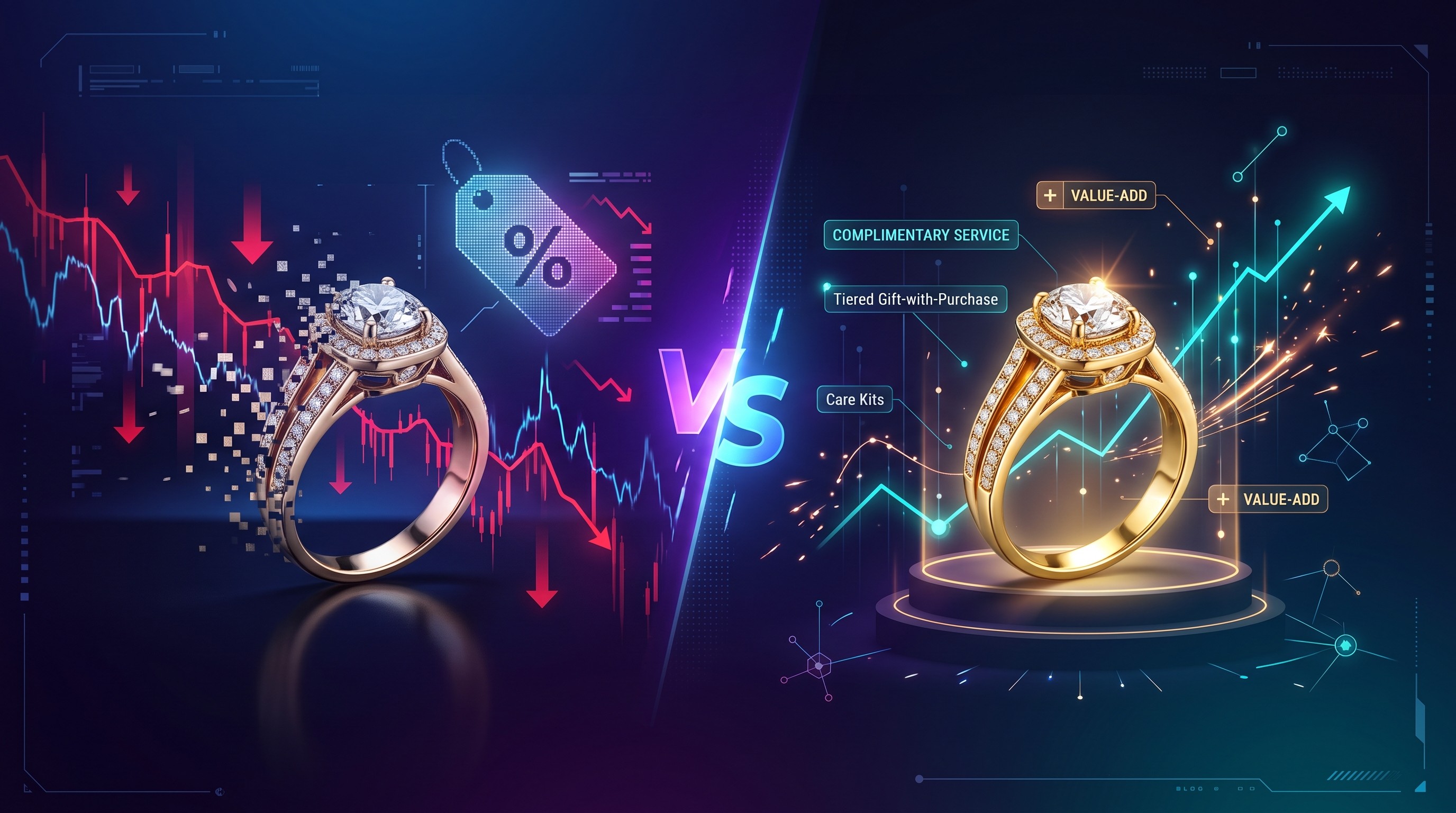
Instead of slashing prices, resilient jewelry operators drive conversions by offering value-add incentives. Tactics like complimentary ring sizing, bundled care kits, custom engraving, and tiered gift-with-purchase (GWP) programs preserve price integrity while providing a tangible reason to buy now.
┌─────────────────────────────────────────────────────────┐
│ THE DISCOUNT TRAP │
│ │
│ 20% Off Sale ──> Cash Flow Spike ──> Margin Compression │
│ │ │
│ ▼ │
│ Trained Deal Seekers │
│ │ │
│ ▼ │
│ Full-Price Sales Drop │
└─────────────────────────────────────────────────────────┘
│
▼
┌─────────────────────────────────────────────────────────┐
│ VALUE-ADD STRATEGY │
│ │
│ Full Price + Free Sizing / Care Kit / Engraving │
│ │ │
│ ▼ │
│ Margin & Equity Intact │
│ │ │
│ ▼ │
│ Higher Customer LTV │
└─────────────────────────────────────────────────────────┘
01The Structural Mechanics of the Jewelry Discount Trap
To understand why price cuts fail high-AOV brands, look at the margin structure. Fine jewelry typically operates on lower inventory velocity than fashion, balanced by higher average order values. A 20 percent discount does not require 20 percent more volume to break even on gross profit dollars; depending on metal and gemstone costs, it often requires a 40 to 60 percent surge in unit sales.
Beyond the math, discounting creates three operational headaches:
- Ad Account Distortion: Meta and Google ad channels learn from pixel signals. When you launch a sale, ad platforms optimize toward price-sensitive shoppers. Once the sale ends, your account continues targeting low-intent traffic that refuses to buy at full price.
- Elevated Return Rates: Sale buyers purchase on impulse. In fine jewelry, impulse buying leads to buyer's remorse, higher customer service tickets, and increased return processing costs.
- Loss of Pricing Power: Once a customer buys a solid gold piece at a discount, they establish that discounted rate as the true market value in their mind. Converting them back to full price becomes nearly impossible.
Non-Discount Incentives That Preserve Margin and Equity
Replacing price cuts requires incentives that cost the business a fraction of their perceived value to the consumer. The goal is to lower purchase friction without lowering the price anchor.
1. Complimentary Sizing and Alterations
Ring sizing is one of the largest conversion blockers in online fine jewelry. Buying a size 7 ring when you are unsure of fit creates friction. Offering free post-purchase sizing removes this hesitation.
The cost to the brand is minimal (often $15 to $35 in bench fees), but the perceived value to the consumer is high. More importantly, it shifts the transaction from a raw sale to a personal service experience.
2. Tiered Gift-With-Purchase (GWP) Strategies
GWP programs allow you to drive urgency during peak seasons without marking down core inventory. The key is offering high-utility items that complement the core purchase:
- Threshold A ($300+ Order): Travel leather jewelry roll (COGS: $8; Perceived Value: $40)
- Threshold B ($750+ Order): Ultrasonic cleaning kit or branded care set (COGS: $18; Perceived Value: $75)
- Threshold C ($1,500+ Order): Fine silver polishing cloth set with a limited travel pouch (COGS: $30; Perceived Value: $120)
Because you buy these gift items at cost, your effective discount percentage remains in the single digits, while your order value increases.
3. Personalization and Custom Services
Offering complimentary laser engraving, hand-stamped initials, or birthstone accents creates immediate emotional attachment. Personalized items carry near-zero return rates, protecting your inventory logistics while adding perceived value to the gift-giver.
How to Structure Your Next Seasonal Promotion
If you are transitioning away from site-wide sales, execute the shift gradually across four core operational steps.
Step 1: Audit True Unit Economics
Calculate your fully burdened margin including COGS, merchant fees, shipping, packaging, and expected return processing. Determine your actual dollar contribution per order before testing any promotional incentive.
Step 2: Build Service-Based Upgrades
Source high-quality complementary items like travel cases, polishing cloths, or sizing tools. Establish clear operational workflows with your bench jewelers or fulfillment center so services like sizing or engraving do not create shipping bottlenecks.
Step 3: Shift Email and Ad Messaging
Reframe promotional messaging away from price drops and toward exclusivity or completeness.
- Instead of: "Black Friday Sale: 20% Off Everything"
- Use: "The Collector's Edition: Complimentary Travel Vault with Every Order Over $500"
Step 4: Track Retainable Value
Measure campaign success by net contribution margin and 90-day repeat purchase rate, rather than top-line revenue during the sale window. Look closely at how these strategies work in practice by reviewing our detailed case studies on fine jewelry growth strategies.
Balancing Constraints and Tradeoffs
Eliminating discounts is not a quick fix. You will likely see lower overall conversion rates from cold traffic that was previously driven by cheap entry points. Top-line volume during promotional weekends like Black Friday may appear lower compared to prior discount-heavy years.
However, net profitability, inventory health, and customer retention metrics almost always improve. You swap low-margin, high-friction revenue for sustainable margin dollars and higher customer satisfaction.
If this sounds familiar, it’s usually a sign the system needs rethinking.
Frequently Asked Questions
Use private arch sales, password-protected vault events for existing VIP customers, or bundle slow-moving pieces with high-margin bestsellers as an exclusive package offer.
You may see a minor drop in initial conversion rate, but average order value and net profit margins usually increase, offsetting the lower transaction volume with healthier revenue.
Aim to keep total incentive cost of goods sold (COGS) below 3 to 5 percent of total order value, compared to standard 15 to 25 percent markdowns.
Instead of a percentage off, offer a complimentary service like free express shipping, a care kit, or a fixed-dollar credit applied to orders well above your average order value.
Focus promotional windows on limited product drops, exclusive gift-with-purchase tiers, or complimentary holiday gift packaging rather than price reductions.
Related Posts
View All ›
An operator's guide to raising jewelry average order value. Learn how to design high-margin bundles, structure post-purchase flows, and use curation instead of margin-cutting discounts.


High-AOV jewelry buyers require reassurance, not faster express checkouts. Here is how operators reduce checkout friction without sacrificing trust or margin.
.jpg&w=3840&q=90)
High-AOV jewelry buyers evaluate social proof differently than low-ticket shoppers. Here is how top operators structure reviews, testimonials, and Google data to drive conversions.