Customer Journey Mapping for Small Businesses: Unlocking Conversion Opportunities
Updated: October 16, 2026
E-commerceQuick Summary
7 min read- 01
For small businesses, every website visitor represents a valuable growth opportunity. Yet, many small business owners face a common, frustrating paradox: healthy traffic levels combined with...
- 02
Understanding the exact path your audience takes from their initial interaction to becoming a loyal advocate is the cornerstone of effective user experience optimization. This process is...
- 03
In this guide, we’ll explore how to build a high-impact customer journey map and translate those qualitative and quantitative insights into actionable Conversion Rate Optimization (CRO)...
- 04
At its core, a customer journey map is a visual representation of the end-to-end experience a user has with your brand. It details every touchpoint, decision stage, emotion, and barrier a...
For small businesses, every website visitor represents a valuable growth opportunity. Yet, many small business owners face a common, frustrating paradox: healthy traffic levels combined with disappointing conversion rates. If prospective buyers are coming to your site but leaving without taking action, the issue rarely lies in your product it lies in your small business conversion funnel.
Understanding the exact path your audience takes from their initial interaction to becoming a loyal advocate is the cornerstone of effective user experience optimization. This process is known as customer journey mapping. By systematically visualizing every touchpoint, small businesses can uncover hidden friction, eliminate barriers to purchase, and unlock substantial growth.
In this guide, we’ll explore how to build a high-impact customer journey map and translate those qualitative and quantitative insights into actionable Conversion Rate Optimization (CRO) strategies.
011. What is Customer Journey Mapping and Why Is It Essential for CRO?
At its core, a customer journey map is a visual representation of the end-to-end experience a user has with your brand. It details every touchpoint, decision stage, emotion, and barrier a prospective buyer encounters as they navigate your digital storefront or service portal.
While traditional marketing models treat conversions as linear events (a user clicks an ad and buys a product), real-world behavior is fluid and multi-dimensional. A buyer might discover your brand via social media, research your solutions on mobile during lunch, read reviews on desktop later that evening, and finally convert days later after receiving a retargeting email.
Why Journey Mapping Drive CRO Success
Conversion Rate Optimization (CRO) is often misunderstood as merely tweaking button colors or writing punchier headlines. True CRO goes deeper it aligns your site’s operational flow with real user behavior.
- Uncovering Hidden Friction: Quantitative data tells you where users leave, but journey mapping explains why they abandon their carts or forms.
- Eliminating Disconnects: It ensures messaging, design, and value propositions remain consistent across all stages of the funnel.
- Prioritizing High-Impact Changes: Rather than guessing what to test next, journey mapping highlights the exact conversion bottlenecks impacting your bottom line.
By connecting user psychology with data analytics, customer journey mapping CRO provides a clear roadmap for sustainable revenue growth.
2. Step-by-Step Guide: Mapping the Small Business Conversion Funnel
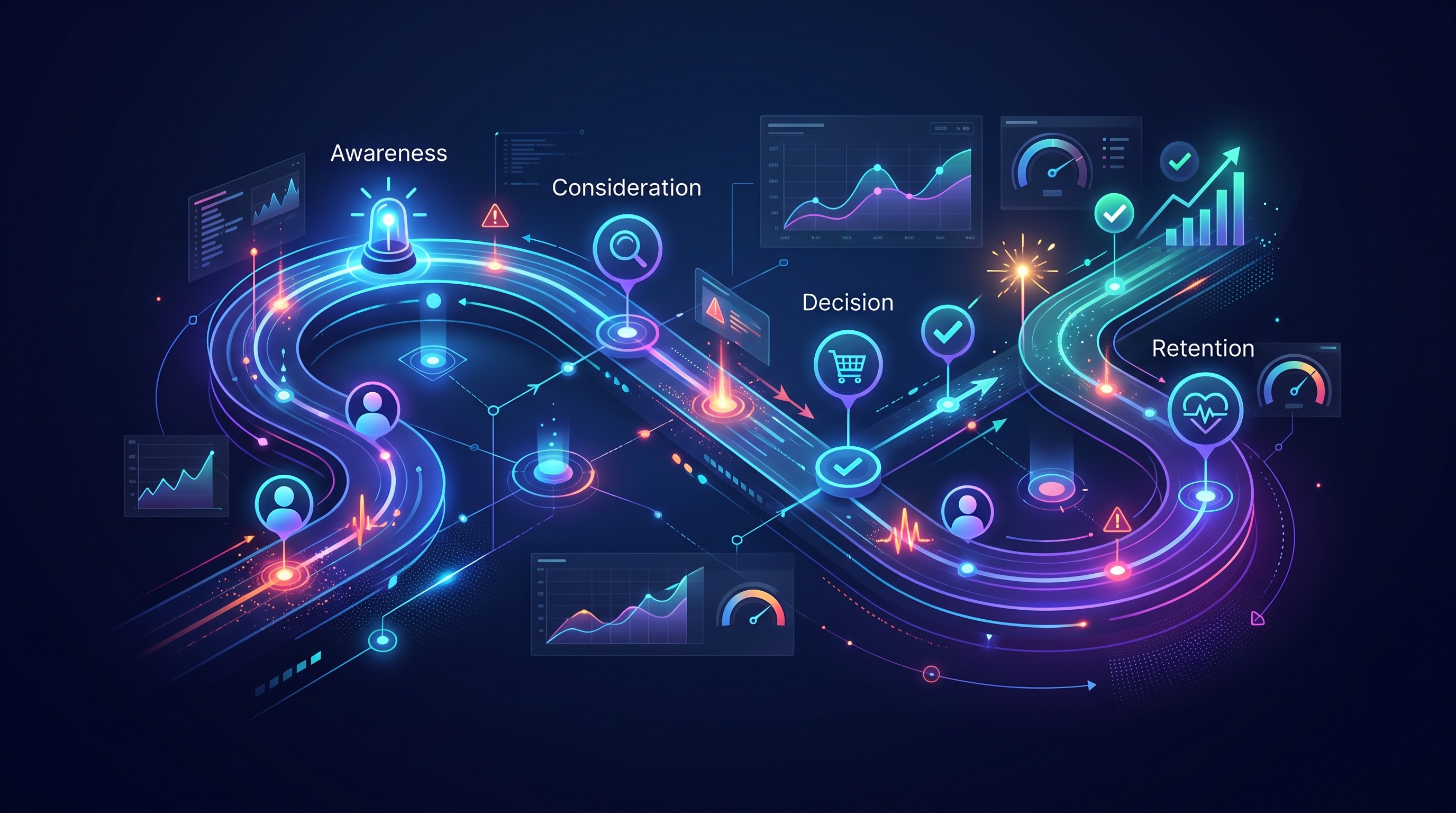
To build a meaningful map, you need to break down the customer experience into digestible stages. While customer journeys vary across industries, most small business funnels comprise four primary phases:
[ Awareness ] ➔ [ Consideration ] ➔ [ Decision ] ➔ [ Retention ]
Stage 1: Awareness
- User Mindset: "I have a problem or need, and I'm looking for options."
- Touchpoints: Search engines (SEO/AEO), social media posts, blog content, paid ads.
- Key CRO Goal: Provide clear, engaging content that answers search intent and introduces your value proposition without aggressive selling.
Stage 2: Consideration
- User Mindset: "I know my options. Is this specific brand right for me?"
- Touchpoints: Service pages, case studies, comparison guides, feature lists, landing pages.
- Key CRO Goal: Reduce cognitive load. Ensure navigation is intuitive, benefits are obvious, and social proof (testimonials, ratings) is front and center.
Stage 3: Decision
- User Mindset: "I'm ready to buy/sign up, but I need reassurance."
- Touchpoints: Checkout pages, pricing tables, contact forms, trial sign-ups.
- Key CRO Goal: Maximize clarity and trust. Remove non-essential form fields, display security badges, offer flexible payment options, and state clear return/guarantee policies.
Stage 4: Retention & Advocacy
- User Mindset: "Did I make the right choice? What happens next?"
- Touchpoints: Post-purchase emails, onboarding workflows, customer support, review requests.
- Key CRO Goal: Turn one-time buyers into repeat customers and brand ambassadors by streamlining post-conversion touchpoints.
3. Gathering Actionable Customer Insights: Tools and Techniques
Creating an effective journey map requires a combination of quantitative and qualitative insight. Relying on assumptions about how customers interact with your brand often leads to misdirected optimization efforts.
1. Web Analytics
Tools like Google Analytics 4 provide the quantitative baseline for your journey map. Look at metric clusters such as:
- Traffic acquisition sources per funnel stage
- Conversion paths and drop-off points
- Average session duration and pages per session To dive deeper into setting up tracking frameworks, check out our Comprehensive Guide to Jewelry Web Analytics.
2. Behavioral Heatmaps and Session Recordings
Quantitative data shows you where users leave, but behavioral visualization reveals what they experienced right before leaving.
- Click Heatmaps: Reveal whether users click on non-clickable elements or miss prominent Calls-to-Action (CTAs).
- Scroll Maps: Show how far down a page users actually read before abandoning.
- Session Recordings: Allow you to watch real, anonymized visitor sessions to spot rage clicks, broken links, or form field hesitation.
3. Direct Customer Feedback
Surveys and feedback loops capture user sentiment directly:
- Exit-Intent Surveys: Ask non-converting visitors a single simple question: "Is there anything stopping you from completing your purchase today?"
- Post-Purchase Surveys: Discover what almost prevented successful buyers from converting.
Analyzing Friction: A Case Study Approach
Imagine an e-commerce business noticing a 70% drop-off rate between the cart and checkout pages. Analytics show high traffic, but heatmaps reveal users repeatedly clicking on an unlinked shipping policy banner.
The friction wasn't product pricing it was uncertainty around delivery costs and timelines. Fixing this simple clarity issue directly lifts conversions without spending an extra dollar on traffic generation.
4. Translating Journey Insights into Actionable CRO Strategies
A map is only useful if it guides your actions. Once friction points are identified, convert those insights into structured, testable optimization hypotheses.
Step 1: Formulate Hypotheses
Use a structured framework for every identified issue:
"Because we observed [Data/Insight], changing [Element] for [Target Audience] will result in [Expected Outcome]."
Example: "Because session recordings show mobile users struggling with a 10-field contact form, reducing the form to 4 essential fields will increase mobile form completions by 25%."
Step 2: Prioritize Optimization Tasks
Not all fixes yield equal results. Use a prioritization framework like ICE (Impact, Confidence, Ease):
- Impact: How much will this change improve conversions?
- Confidence: How certain are we based on our analytics and user research?
- Ease: How quickly and cost-effectively can our team implement this fix?
Step 3: Test and Iterate
Implement changes using standard testing approaches (such as A/B testing or direct split testing). Measure performance against your baseline metrics, refine, and re-map the journey continuously. Discover how full-funnel testing works with our custom CRO Services and Solutions.
5. How Useryze Simplifies Customer Journey Analysis & Optimization
Mapping customer journeys and converting data into higher revenue can feel overwhelming for growing businesses. Managing separate analytics platforms, heatmap plugins, and testing tools often leads to data silos and fragmented strategies.
Useryze bridges this gap by combining journey mapping analytics, behavioral insights, and expert conversion rate optimization into a single, cohesive workflow.
With Useryze, you can:
- Visualize Your Small Business Conversion Funnel: Instantly track how visitors move through every stage of your website.
- Pinpoint Friction Automatically: Identify drop-offs, rage clicks, and form abandonment areas without spending hours sifting through raw data logs.
- Implement High-Impact CRO Strategies: Rely on data-backed recommendations designed specifically to maximize ROI for small and mid-sized businesses.
Whether you're looking to polish your landing pages or revamp your entire user journey, Useryze provides the technology and strategic guidance needed to turn passive visitors into loyal customers.
Ready to Turn Visitors into Loyal Customers?
Stop guessing what your customers want. Map their journey, eliminate friction, and watch your conversion rates climb.
Explore Useryze's Data-Driven CRO Services Today or Schedule a Free Journey Optimization Audit to start unlocking new revenue opportunities across your entire funnel.
Related Posts
View All ›.png&w=3840&q=90)
Discover how a conversion funnel audit can revolutionize your marketing strategy. Learn actionable data driven insights that reveal hidden opportunities and ignite every step of your customer journey for lasting success


In the fast-moving world of digital marketing, two concepts often dominate conversations: targeting and conversion optimization.

In the business world, the temptation to "do it all" is strong. Offering 10 different services to anyone and everyone feels like the safest way to attract more clients and generate more revenue. But here’s the counterintuitive truth: focusing on a specific niche can have a much bigger impact on your business’s growth and sustainability.