Website Speed & Core Web Vitals: The Unsung Heroes of CRO
Updated: October 16, 2026
E-commerceQuick Summary
6 min read- 01
In digital marketing, Conversion Rate Optimization (CRO) often brings to mind A/B testing, persuasive copywriting, eye-catching Call-to-Action (CTA) buttons, and streamlined checkout...
- 02
No matter how compelling your offer or brilliant your copy, potential customers won't convert if your site takes too long to load or responds sluggishly to their interactions.
- 03
This is where website speed conversion rate optimization comes into play. Google’s Core Web Vitals have elevated performance metrics from technical checklists into primary drivers of user...
- 04
Google introduced Core Web Vitals as a standardized set of metrics to quantify real-world user experience. Rather than looking merely at when a server responds, Core Web Vitals evaluate how...
In digital marketing, Conversion Rate Optimization (CRO) often brings to mind A/B testing, persuasive copywriting, eye-catching Call-to-Action (CTA) buttons, and streamlined checkout funnels. While these elements are crucial, a critical foundation is frequently overlooked: performance.
No matter how compelling your offer or brilliant your copy, potential customers won't convert if your site takes too long to load or responds sluggishly to their interactions.
This is where website speed conversion rate optimization comes into play. Google’s Core Web Vitals have elevated performance metrics from technical checklists into primary drivers of user experience and revenue. Understanding how Core Web Vitals CRO works and leveraging technical SEO for conversions allows you to turn technical efficiency into a distinct competitive advantage.
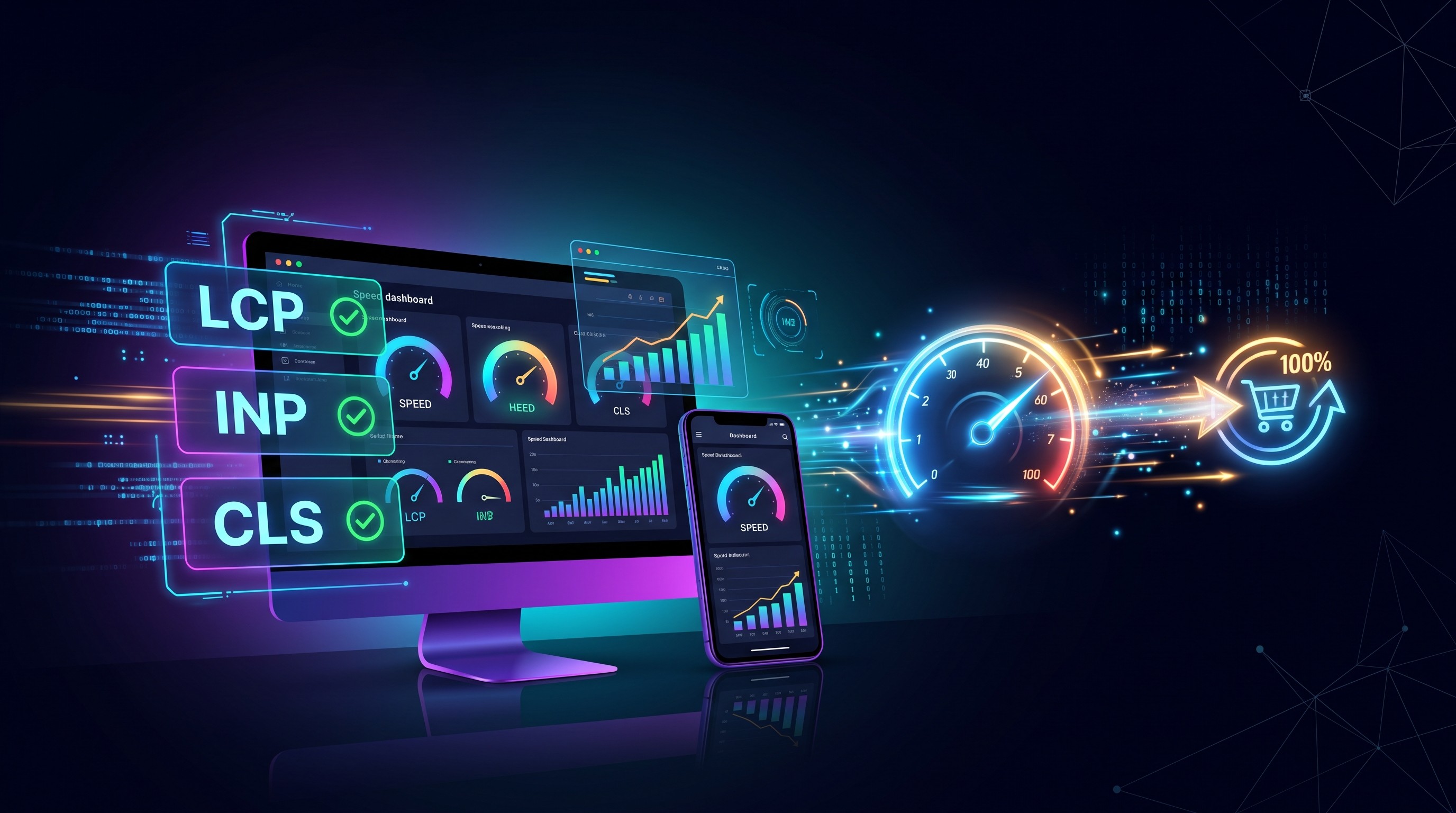
011. Demystifying Core Web Vitals (LCP, INP, CLS)
Google introduced Core Web Vitals as a standardized set of metrics to quantify real-world user experience. Rather than looking merely at when a server responds, Core Web Vitals evaluate how fast a page loads, how quickly it becomes interactive, and how stable it remains as content renders.
CORE WEB VITALS BENCHMARKS
┌─────────────────────────────────────────┐
│ LCP (Largest Contentful Paint) │
│ [ Good: ≤ 2.5s ] [ Needs Work ] [ Poor ]│
├─────────────────────────────────────────┤
│ INP (Interaction to Next Paint) │
│ [ Good: ≤ 200ms ] [ Needs Work ][ Poor ]│
├─────────────────────────────────────────┤
│ CLS (Cumulative Layout Shift) │
│ [ Good: ≤ 0.1 ] [ Needs Work ] [ Poor ]│
└─────────────────────────────────────────┘
Largest Contentful Paint (LCP)
- What it measures: Loading performance. Specifically, LCP marks the point in the page load timeline when the main content (e.g., hero image, primary heading, banner) has likely loaded.
- Target Benchmark: 2.5 seconds or faster.
- Impact on User Experience: If visitors stare at a blank or half-rendered screen for more than 2.5 seconds, bounce rates rise sharply.
Interaction to Next Paint (INP)
- What it measures: Visual responsiveness. INP evaluates a page's overall responsiveness to user interactions (clicks, taps, and key presses) throughout the entire visit.
- Target Benchmark: 200 milliseconds or less.
- Impact on User Experience: When a user clicks "Add to Cart" or opens a navigation menu, high INP causes frustrating delays, leading consumers to believe the site is frozen or broken.
Cumulative Layout Shift (CLS)
- What it measures: Visual stability. CLS tracks unexpected layout shifts that occur while the page loads.
- Target Benchmark: 0.1 or less.
- Impact on User Experience: High CLS causes accidental clicks such as tapping "Cancel" instead of "Confirm" because a banner ad suddenly pushed content downward. This friction harms user trust instantly.
2. How Slow Websites Kill Conversions
The connection between page speed and revenue is well-documented. Modern digital consumers expect instantaneous experiences; when expectations aren't met, abandonments increase immediately.
The Cost of a 1-Second Delay
Studies consistently show that a 1-second delay in page load time can reduce conversion rates by up to 7%.
For an e-commerce business generating $100,000 per day, a one-second delay could result in $2.5 million in lost sales annually.
Impact of a 1-Second Delay on Performance:
-----------------------------------------
• 11% Fewer Page Views
• 16% Decrease in Customer Satisfaction
• 7% Loss in Conversions
The Psychology of Speed and Friction
When a user arrives on a website, trust is evaluated within milliseconds.
- Cognitive Load & Frustration: Slow rendering increases cognitive friction. Users subconsciously associate speed with security and professionalism.
- Mobile Vulnerability: Mobile users often browse on variable cellular networks. A heavy site that loads moderately fast on desktop can become unusable on mobile devices, alienating a major source of traffic.
- Cart Abandonment: The highest drop-off rate typically occurs during the transition from product pages to cart and checkout. High INP or slow LCP on payment processing pages directly impacts revenue.
3. Practical Tips for Improving Website Speed and Core Web Vitals
Optimizing performance requires a balance of developer-level fixes and content management strategies. Here are actionable steps to improve performance:
A. Next-Gen Image Optimization
Images account for a large portion of overall page weight.
- Modern Formats: Convert legacy JPEG and PNG files into WebP or AVIF, which offer superior compression without loss of quality.
- Responsive Sizing: Use the
srcsetattribute to serve appropriately sized images based on the user's screen resolution. - Responsive Lazy Loading: Add
loading="lazy"to off-screen images, ensuring critical above-the-fold assets load first. - Explicit Dimensions: Always set
widthandheightattributes on images and video wrappers to prevent layout shifts and improve CLS.
B. Advanced Caching Strategies
- Browser Caching: Set long cache-control headers for static resources (CSS, JS, media files) so returning visitors load pages faster.
- Content Delivery Networks (CDNs): Use CDNs (such as Cloudflare, Fastly, or CloudFront) to distribute content geographically closer to users, lowering latency and improving LCP.
C. Code Minification and Asset Delivery
- Minify CSS, JavaScript, and HTML: Remove unnecessary whitespace, comments, and long variable names to decrease file sizes.
- Defer Non-Critical JavaScript: Use
deferorasynctags for scripts that aren't essential for initial rendering (like analytics or tracking scripts). - Eliminate Render-Blocking Resources: Inline critical CSS required for above-the-fold content and load remaining stylesheets asynchronously.
D. Mobile Responsiveness and Optimization
- Prioritize Mobile-First Code: Ensure design breakpoints load lightweight layouts on mobile devices.
- Reduce Third-Party Scripts: Audit and clean up unused tracking pixels, chat widgets, and plugins that execute heavy JavaScript threads and degrade INP.
4. The Synergy Between Technical SEO and CRO
Historically, SEO teams focused on driving traffic, while CRO teams focused on converting that traffic. Modern search engines have unified these disciplines through Core Web Vitals.
┌─────────────────────────┐
│ TECHNICAL SEO & CRO │
│ ALIGNMENT │
└────────────┬────────────┘
│
┌───────────────┴───────────────┐
▼ ▼
Higher Search Rankings Better User Experience
(Driven by PageSpeed) (Lower Friction & Delays)
│ │
└───────────────┬───────────────┘
▼
MAXIMIZED REVENUE & ROI
Why Technical SEO Drive Conversions
- Search Rankings: Google uses Core Web Vitals as an explicit ranking factor. Better scores mean improved visibility and higher-intent organic traffic.
- Lower Bounce Rates: Improving speed and visual stability keeps visitors on-site longer, giving marketing copy and CTAs more opportunities to perform.
- Maximizing Ad Spend: Page speed directly impacts Google Ads Quality Score. Faster landing pages reduce cost-per-click (CPC) and improve ad placement, stretching ad budgets further.
By integrating technical SEO for conversions, marketing strategies become more cohesive. Instead of spending more to bring users to an inefficient page, optimizing performance maximizes the yield of existing traffic.
5. How Useryze Helps Optimize Your Performance
Optimizing Core Web Vitals while balancing functionality can be complex. Useryze simplifies this process with data-driven performance and conversion management.
Useryze identifies technical friction points, pinpoints exact code bottlenecks, and aligns site performance directly with business KPIs.
What Useryze Delivers:
- In-Depth Performance Audits: Real-user monitoring (RUM) and lab data audits to isolate high LCP, INP, and CLS scores.
- Integrated Technical Optimization: Advanced code optimization, asset prioritization, and server configuration to improve speeds without breaking functionality.
- Conversion-First Technical SEO: Combining technical fixes with conversion optimizations to ensure fast page loads lead to measurable sales growth.
Ready to reduce drop-offs and turn site speed into a profit driver?
- Explore our specialized Technical SEO Services to improve organic visibility and Core Web Vitals scores.
- Partner with us for Conversion Rate Optimization (CRO) Services to turn high-performing traffic into revenue.
- Contact Useryze Today for a tailored performance audit.
Related Posts
View All ›
In the world of digital marketing and ecommerce, Conversion Rate Optimization (CRO) is a well known strategy for increasing the percentage of website visitors who take a desired action whether that’s making a purchase, signing up for a newsletter, or filling out a form. But beyond improving performance, a key question often arises: Can CRO help you forecast revenue?


In the world of digital marketing, Pay Per Click (PPC) advertising is often seen as the fast track to generating leads and driving traffic.
.png&w=3840&q=90)
Jewelry converts at under 1% on average — the lowest of any ecommerce category. Here is what CRO is, why it matters more for jewelry than almost any other vertical, and where to start.