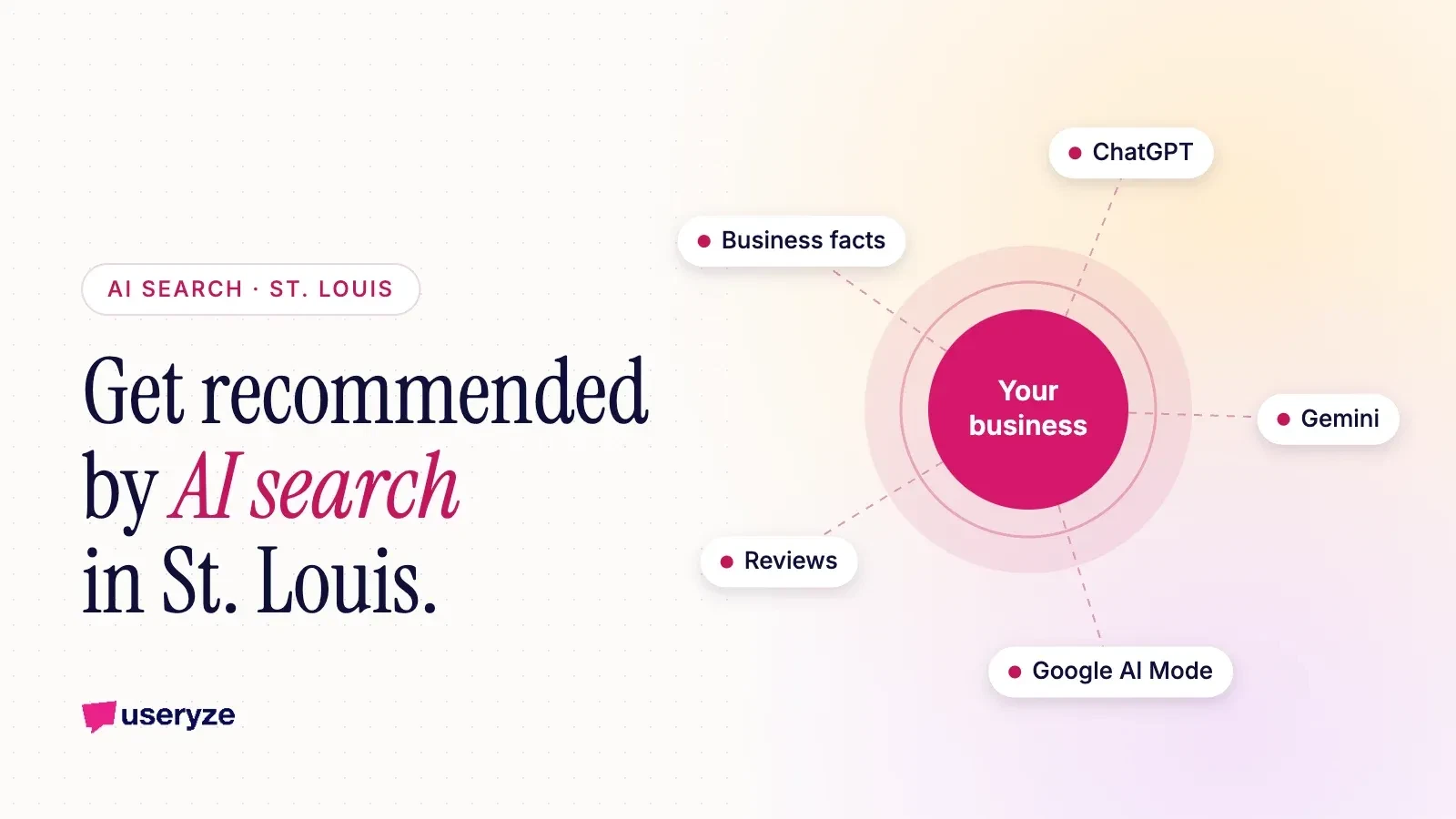
How St. Louis Businesses Get Recommended by ChatGPT and Google AI
Quick Summary
4 min read- 01
More St. Louis customers now start with a question, not a search. They ask ChatGPT, Gemini or Google's AI Mode things like "recommend a good family dentist in Kirkwood" or "who does kitchen...
- 02
No one can guarantee an AI recommendation. But you can make your business much easier for these tools to find, understand and trust. This guide shows how.
- 03
ChatGPT, Gemini and Google AI Mode are different systems. They search and summarize differently, and they often recommend different businesses for the same question. When we tested the same...
- 04
Repeat the test every few weeks. Answers change, so you are looking for patterns, not a single score.
More St. Louis customers now start with a question, not a search. They ask ChatGPT, Gemini or Google's AI Mode things like "recommend a good family dentist in Kirkwood" or "who does kitchen remodels in St. Charles". These tools answer with a short list of businesses. If yours is not on it, the customer may never see you.
No one can guarantee an AI recommendation. But you can make your business much easier for these tools to find, understand and trust. This guide shows how.
01The tools do not all give the same answer
ChatGPT, Gemini and Google AI Mode are different systems. They search and summarize differently, and they often recommend different businesses for the same question. When we tested the same prompt for independent jewelers in a Texas city across all three tools, they named eight different businesses between them. So there is no single ranking to chase. The goal is to be clearly described in the places all of these tools read.
Step 1: Test what AI says about you today
Before changing anything, run a simple test:
- Write three questions a real customer might ask, including your service and a St. Louis place, such as "best HVAC company in South County" or "affordable wedding photographer St. Louis".
- Ask each question in ChatGPT, Gemini and Google AI Mode.
- Record whether your business appears, whether the details are right, which competitors appear and which sources are cited.
Repeat the test every few weeks. Answers change, so you are looking for patterns, not a single score.
Step 2: Make your business facts consistent everywhere
AI tools pull from your website, your Google Business Profile, directories, reviews and articles that mention you. When those sources disagree, the tools are less likely to recommend you. Check that these match exactly:
- Business name, address and phone number.
- Hours and service areas, including which parts of the St. Louis metro you cover.
- Categories and main services.
- Website address.
Fix old listings, duplicate profiles and outdated addresses first. It is unglamorous work that pays off.
Step 3: Explain your services clearly on your own site
AI tools favor clear, specific, helpful pages. For each main service, publish a page that answers:
- What the service is and who it is for.
- Where you offer it, naming the St. Louis areas you serve.
- What the process looks like and how long it takes.
- Prices or price ranges, if you can share them.
- The questions customers ask before buying.
Write it for a customer, not for search engines. Plain answers are easier for both people and AI tools to use.
Step 4: Build real proof
AI answers often lean on reviews and third-party mentions. Strengthen them by:
- Asking every happy customer for a Google review that mentions the service.
- Getting listed with local organizations, chambers and industry associations.
- Earning mentions in local news, neighborhood blogs, event pages and partner sites.
- Showing real case examples on your site, with permission.
Never post fake reviews or invented results. Beyond the ethics, they put your profile at risk.
Step 5: Keep the technical basics in order
- Make sure your important pages can be crawled and indexed. Check them in Google Search Console.
- Use structured data to describe your business, services and location.
- Give each page a unique, descriptive title and meta description.
- Link related pages together so it is clear what you offer and where.
Step 6: Measure the right things
Some AI visibility shows up in Google Search Console, which now reports impressions from AI features for many sites. But most of it is not measured anywhere directly. Track what you can:
- Your repeated prompt tests.
- Search Console impressions and clicks for your service and area keywords.
- Calls, forms and bookings, with a "How did you hear about us?" question that includes AI tools as an option.
Is this different from SEO?
Mostly it is good SEO done thoroughly: accurate business information, helpful pages, real reviews and a site search engines can read. Google still powers much of what AI tools find. The difference is that being clearly described across many sources now matters even more.
Start this week
- Run three customer-style prompts in ChatGPT, Gemini and Google AI Mode.
- Fix any wrong details you find, starting with your Google Business Profile.
- Improve the one service page closest to your best customers.
Our AI search visibility service runs these tests and fixes for businesses, alongside local SEO. See how we work with businesses across Greater St. Louis, or read our St. Louis local SEO guide.
Free growth plan
Turn this into more customers.
We run marketing, video and AI follow-up for owner-led businesses. Tell us about yours and we will show you the three fixes that matter most.
Related Posts
View All ›
How St. Louis businesses rank on Google Maps across the city, St. Louis County, St. Charles and the Metro East: profiles, area pages, reviews and tracking.

What a St. Louis business website needs to turn local visitors into calls: speed on phones, service and area pages, local proof and one clear next step.
Set up Google and Meta ads that bring St. Louis customers: targeting across Missouri and Illinois, landing pages, call tracking and a weekly checklist.